Valorie Kondos Field and Sam Peszek on Walking With Your Team
Why the Best Leaders Stop Leading From the Front
You got promoted because you were excellent at your job. You know what it takes to succeed, and you have the receipts to prove it.
And now you're leading people who aren't like you at all.
They didn't grow up in elite training environments. They don't think in goals and timelines the way you do. They didn't wake up at five, saying, "I'm going to dominate today." Some of them are still figuring out what they want, who they are, and why they're even here.
And you're standing in front of them, wondering why they won't just do what you do.
There's a version of leadership you learned that says: lead by example. Show them what excellence looks like. Move fast. Raise the bar. Let them figure it out or get out of the way.
But there's something that version is missing.
The Day Sam Learned How to Actually Lead
Valorie Kondos Field—Miss Val—has won seven NCAA national championships at UCLA. She's coached Olympic athletes and Hall of Famers. For decades, she's built one of the most successful programs in college gymnastics.
Samantha Peszek was one of those athletes. Olympic silver medalist. Three-time NCAA champion. Everything you think of when you picture an elite gymnast.
When Sam came to UCLA as a freshman, she led the way she knew: the best way. Which meant everyone should just follow her. Match her intensity. Share her drive. If you didn't, something was wrong with you.
Then, there was a meet at the University of Utah where the team did not perform as Sam expected.
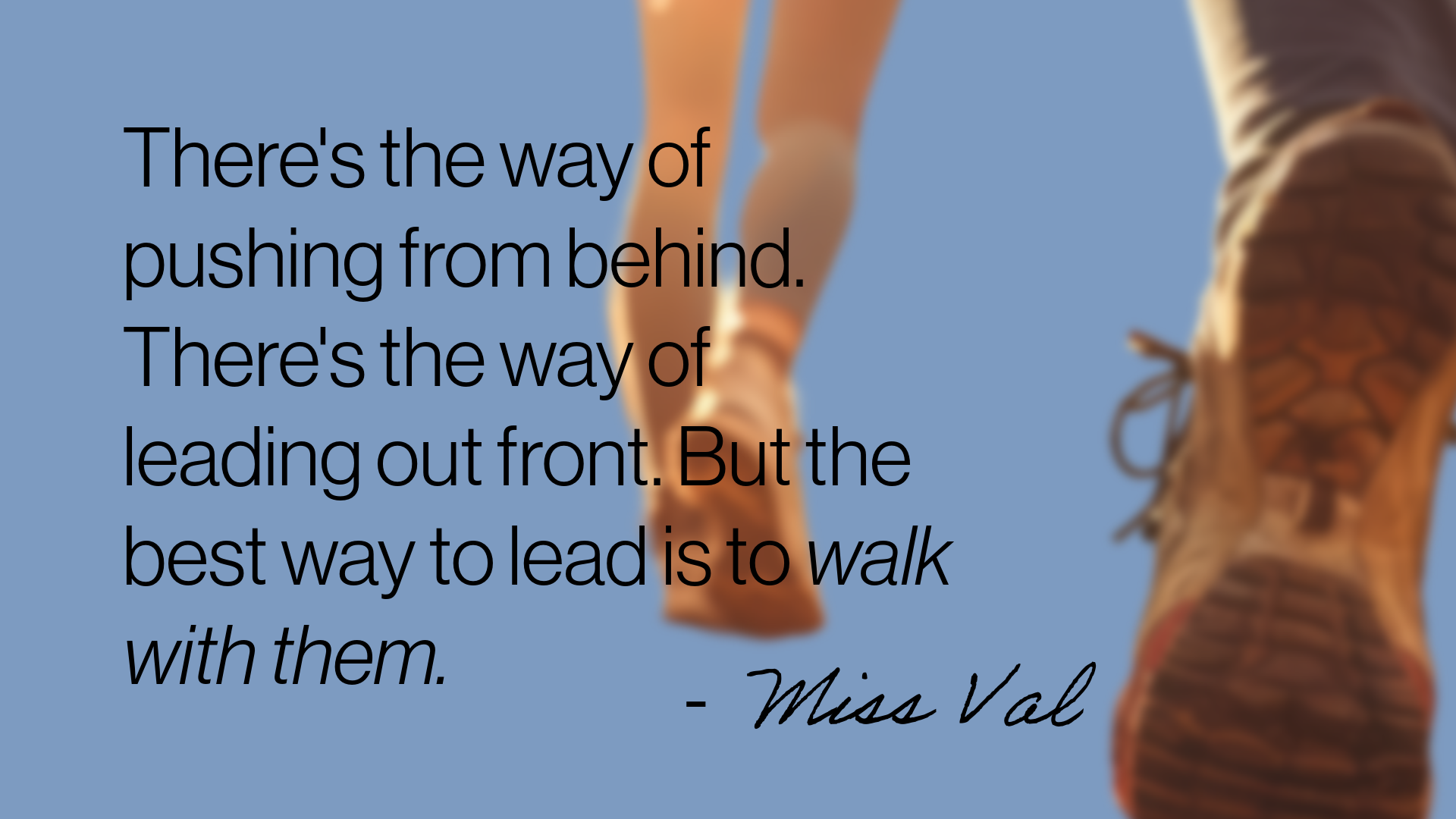
Walking out of the tunnel, Miss Val pulled Sam aside and said something simple: "Sam, this is how you lead. There's the way of pushing from behind. There's the way of leading out front. But the best way to lead is to walk with them."
And she meant it.
Not to motivate them. Not to inspire them. Not to drag them along while you prove you're the best. Walk. With. Them. Through the muck. Through the struggle. Through the parts they don't understand.
Sam had no idea at the time how much that one moment would change everything.
What Happens When Everyone Has a Different Brain
Here's the uncomfortable truth about leading.
You can't assume everyone wants what you want or thinks the way you think.
It sounds obvious now. But it's the thing most high-performing leaders get wrong.
When Sam started working with younger gymnasts at Beam Queen, her camp for building confidence and resilience, she realized something that shouldn't have been a revelation but was: everyone's brain is different.
The elite world Sam came from? Everyone shared the same ingredients. They wanted the same things. They trained the same way. The only variable was the motivational speech.
But the world of regular people—which is most people—doesn't work that way.
You can't lead someone by assuming they think like you. And the moment you realize that, everything shifts.
The Question That Changes Everything
Val asks open-ended questions. That's not new advice. But she asks them specifically because she knows people will fill in the blanks with their own narrative if you don't.
An athlete hears "we're doing extra conditioning" and thinks: My coach thinks I'm fat.
A team member hears "we need to change the process" and thinks: I did something wrong.
A direct report hears "let's grab coffee" and thinks: Am I getting fired?
These aren't truth. They're the stories people tell themselves when you don't explain the why.
Val and Sam both talk about this constantly: front-load everything. Don't let people think the different story. Because once they believe something—even when you give them facts, research, proof—they dig their heels in deeper. It's not stubbornness. It's neuroscience.
The practice is simple: explain why before you explain what. Build alignment before you expect action.
But here's where most leaders stop.
Safe Spaces Don't Actually Teach Growth
Val loves hard conversations. She says it explicitly. And she's frustrated by the way "safe space" has become code for "no one will challenge anyone ever."
Because that's not where growth happens.
Growth happens in a safe space plus a respectful conversation. The safety is the container. The conversation is where the work actually occurs.
Val once facilitated a discussion about transgender athletes in women's sports. When one athlete tried to end it with "can we just agree to disagree?" Val shut that down immediately. "There's no growth in agree to disagree."
That's not being mean. That's respecting people enough to actually engage with what matters to them instead of protecting them from anything hard.
And that applies whether you're coaching NCAA athletes or managing a marketing team.
What Transparency Actually Costs
When Sam manages her team of over 100 summer staff members, she does something radical: she explains her decisions.
Not just the what. The why. The context. The problems she's trying to avoid.
"We're doing it this way because in the past, this is what happened. We're choosing this to eliminate these problems. If you have a better idea, I'm not married to this—let me know. But this is what we're trying to solve for."
One sentence later: "Oh, everything she does has a reason."
And now people can ask. Now people can suggest better ideas. Now you've shifted from compliance to collaboration.
The cost? Time. It takes longer to explain than to command.
But the payoff is people who actually understand where you're going and why it matters to get there.
Where Grace Becomes Leadership
Both Val and Sam use the word grace repeatedly. And they're specific about what they mean.
Grace isn't weakness. It's not avoiding feedback. It's not accepting mediocrity.
Grace is giving someone the benefit of the doubt that what you think they're thinking isn't actually true. It's assuming they have their own truth, their own context, their own reasons.
Val stops assuming people aren't paying attention. Maybe they are. Maybe they're just struggling in ways she can't see.
Sam stops assuming everyone wakes up with the same goals and mentality. Maybe they wake up scared. Maybe they wake up grieving. Maybe they wake up wondering if they belong.
When you lead with grace, you listen differently. You ask differently. You see differently.
And your team does something remarkable: they start showing up as their actual selves instead of performing who they think you want them to be.
Your Next Step (And It's Not Complicated)
If you're a successful person promoted to lead other people—people who didn't necessarily follow your exact path—here's what matters:
Your excellence got you the seat. But your presence keeps you there.
Start with one conversation. Pick someone on your team you've been assuming you understand. Ask them what they actually need. Not what you think they need. Not what worked for you. What they actually need.
Then listen like your job depends on it.
Because it does.
This doesn't mean abandoning high standards. It means understanding that sustainable performance comes from people who trust you and believe in the direction, not from people who are afraid of you or performing for you.
The world is changing. The people coming in now—Gen Z, newer workforces—they're willing to bring their humanity to work. They want to know the why. They expect transparency. They need leaders who can walk with them instead of stand above them.
And honestly? They're asking for the kind of leadership that should have existed all along.
More From Val and Sam
Valorie Kondos Field is a Hall of Fame coach, seven-time NCAA National Champion, and leadership advisor. She's worked with Foster Mobley for nearly two decades, transforming her coaching philosophy and the culture at UCLA Gymnastics.
Samantha Peszek is an Olympic silver medalist, three-time NCAA champion, entrepreneur (Beam Queen), and NBC sports broadcaster. She's equally comfortable in the gym, the boardroom, and on-camera—and she brings the same commitment to growth and grace to all three.
Together, they prove that the best leaders aren't the ones who know everything. They're the ones willing to learn from anyone, walk alongside anyone, and create spaces where people do their best thinking and bravest work.
Continue the Conversation
This one's about showing up as a whole person, not a performance. About what happens when you stop trying to make everyone like you and start trying to understand them.
Watch on YouTube| Subscribe to Step Wise
Want these conversations delivered to your inbox? Sign up for our email list and get a heads-up when new episodes drop—plus occasional reflections from Foster that don't make it to the podcast.
If this shifted something for you, share it with someone who needs to hear it.
Set the table. Invite cool people. Magic happens.
—Foster